Bingo is one of the few Christmas games that works for a three-year-old, a teenager and a grandparent in the same room. The rules are short, the turns are quick, and nobody has to perform. The printable cards do the rest.
This guide shows how to run a Christmas bingo game with printable cards, which variation fits which group, how to print and cut the set, and how to keep a mixed-age table happy. It also explains what is in the 40-card Christmas set in this shop.
What you need
- One bingo card per player or pair.
- One calling sheet or a set of calling cards for the adult.
- Small markers: buttons, coins, stickers, beans or a pencil.
- A small prize per winner, optional.
- A table or a floor space with enough room to see the card.
That is the whole setup. You do not need a bingo cage, a projector or an app.
How to play in five steps
- Give every player a card. If two players have the same card, that is fine for a small game, but different cards make it fairer.
- Shuffle the calling cards. Put them in a bag or a bowl so the order is random.
- Call one picture or number at a time. Show the card or say the word clearly, then wait a moment.
- Players cover the match. If the picture is on their card, they put a marker on it.
- The first player with the winning pattern calls bingo. Check the card against the called cards before giving the prize.
Choose the winning pattern before the first round. A full card is slow for young children. A line, a cross or four corners keeps the game short.
Three variations for different groups
Picture bingo for young children
Use cards with Christmas pictures instead of numbers: a tree, a star, a stocking, a snowman, a gift, a bell. Children who cannot read yet can play without help. Call the picture and show the card at the same time.
Keep the grid small for ages 3 to 5. A 3x3 or 4x4 grid is enough. Play for a line, not a full card. Ten minutes is a good round.
Number bingo for older children and adults
Use the familiar number grid and a calling sheet. This is the version most adults already know. It works well for a mixed table after a meal, when people want to sit and talk between rounds.
For a large group, play in pairs. One person marks the card, the other checks the calls. Pairs make the game social and reduce arguments about a missed number.
Mixed-age table
Use picture cards with a 4x4 grid and call the pictures slowly. Pair a younger child with an adult or an older child. Play two short rounds instead of one long round. The second round gives the first-round winners a chance to help someone else.
If the group is large, divide into tables of four to six and let each table run its own game with one caller. It is easier than one huge game and lets people talk.
Printing and cutting
- Print on normal paper for one-time use. Use thicker paper or cardstock for cards you want to keep.
- Print one calling sheet for the adult. If the set has calling cards, cut them before the guests arrive.
- Keep the cards in a folder with the markers and the prize. A set that is ready to go gets used again.
- Laminate the cards or use sheet protectors if you want to reuse them. Dry-erase markers wipe off.
- Check the printer setting: US Letter and A4 are both included, so choose the paper you have.
A four-card set is enough for a small family. A 40-card set covers a classroom, a large family party or a Christmas Eve table with cousins.
Calling tips that keep the game moving
- Shuffle the calling cards before every round.
- Call the picture or number, then show it. Some children need the picture, not just the word.
- Wait five seconds before the next call. Rushing makes people miss matches and argue.
- Keep the called cards visible in a row so a winner can be checked quickly.
- Announce the winning pattern before the game, not after someone shouts bingo.
- If a round drags, end it and start a new one. A short game that finishes is better than a long game that loses the room.
Prizes and fairness
You do not need a prize table. A chocolate coin, a sticker, a paper crown or the right to choose the next game is enough. If you give a prize, keep it the same for every winner.
For a classroom, a certificate or a small stationary item works. Avoid prizes that create a big difference between winners and everyone else.
What is in the Christmas bingo set
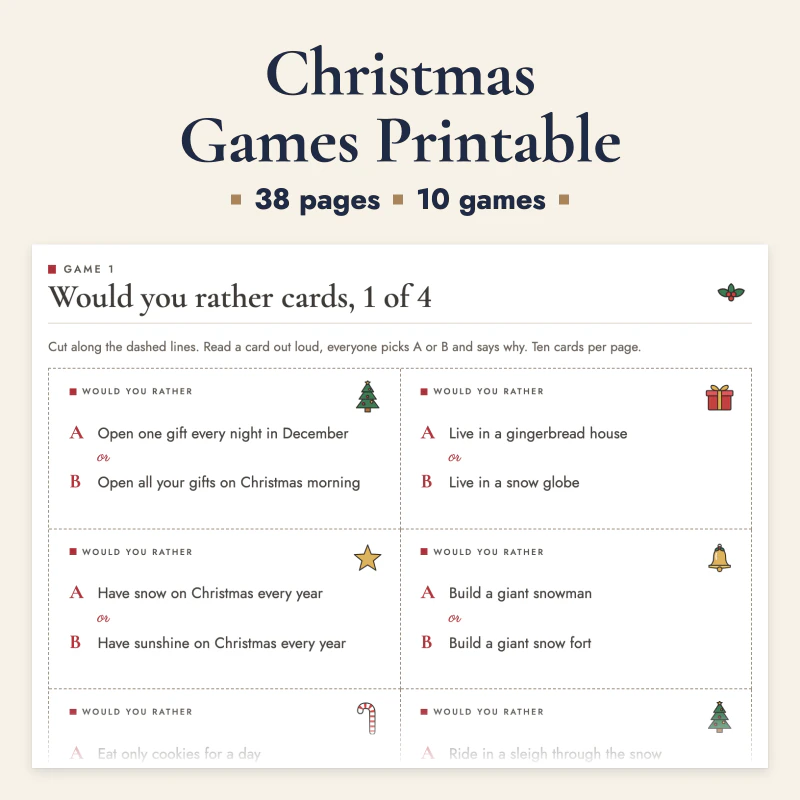
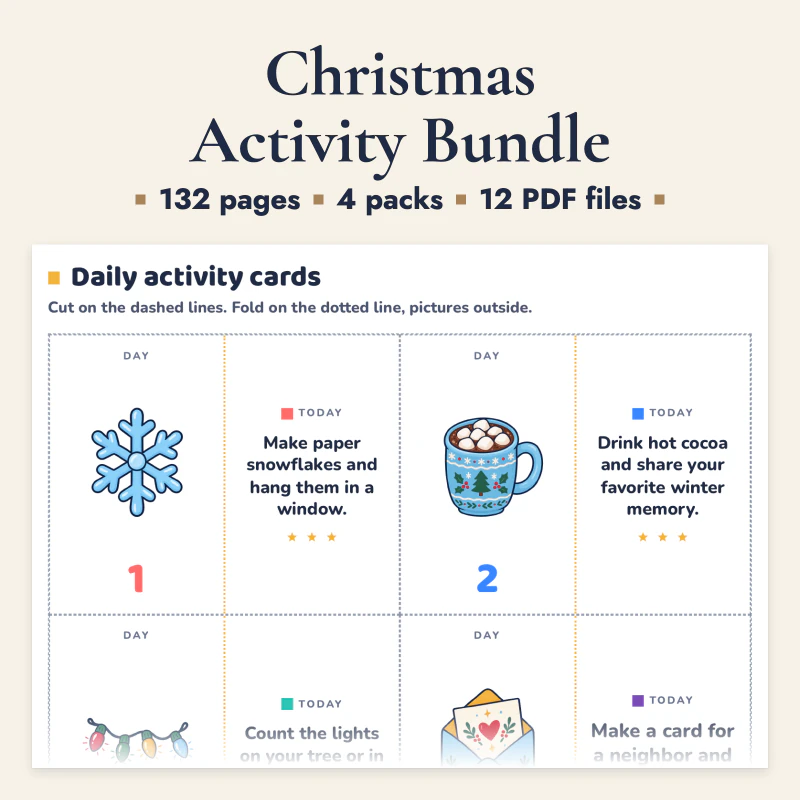
The Christmas Complete Kit includes a picture bingo set with 40 different cards and 45 pages, plus a calling sheet. The cards use Christmas pictures, so younger children can play without reading. The same kit also includes the Advent Calendar for Kids, a Christmas coloring book, a winter activity pack, 10 family games and 480 coloring pages.
The full kit is 14.99 EUR, one time, with the files in US Letter and A4. Nothing is shipped. You print the pages you need and keep the rest for another year.
See the Christmas Complete Kit
If you only want to try the format, the free Christmas sampler includes one bingo card and a few other pages. It is a good way to check the size and the printing before you buy the full set.
A simple Christmas Eve plan
- Print the bingo cards and the calling sheet in the morning.
- Put the markers and the calling cards in one bowl.
- Play one round after dinner, before gifts.
- Use a line or four corners, not a full card.
- Keep the second round for the moment when the table gets quiet.
Two rounds are enough. The game is there to give everyone something to do together, not to fill the whole evening.
Frequently asked questions
How many Christmas bingo cards should I print?
Print one card per player or per pair, plus two spare cards for late arrivals. For a classroom, print one per child and one calling sheet for the adult. A set of 40 different cards is enough for most family parties.
What do you use as bingo markers?
Anything small works: buttons, coins, stickers, dried beans, or a pencil to cross off the pictures. For reusable cards, laminate them or put them in a sheet protector and use dry-erase markers.
What is the difference between picture bingo and number bingo?
Picture bingo uses Christmas pictures instead of numbers, so children who cannot read yet can play. Number bingo uses the familiar 1 to 75 grid and works better for older children and adults.
How long does a Christmas bingo game take?
Plan 10 to 15 minutes for one round and two or three rounds for a party. A full card takes longer than a line; a line or a cross keeps the game moving for younger children.
Can you play Christmas bingo in a classroom?
Yes. Print one card per child, keep the calling cards in a bag, and explain the winning pattern once. Picture bingo works well for preschool and early elementary; number bingo works for older grades.
Do you need prizes for Christmas bingo?
No. A small treat, a sticker, a paper crown or the right to choose the next game is enough. If you give a prize, keep it the same for every winner so nobody feels left out.