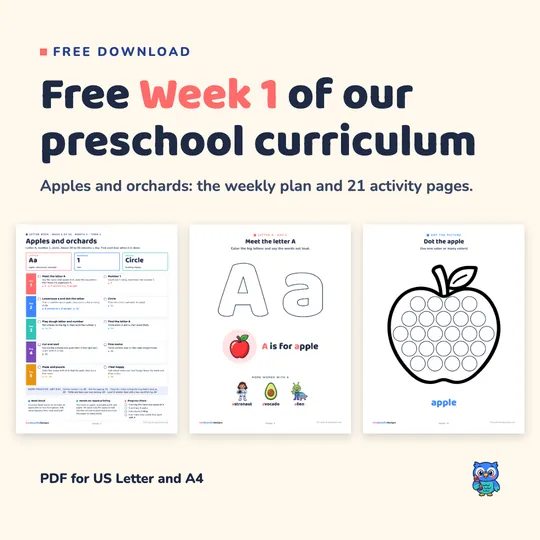
A letter of the week program focuses on one letter for five days, using short, repeated activities such as tracing, building, finding and sorting. For children aged 3 to 5, that repetition is the point: seeing and handling the same letter in several ways helps it stick without pressure.
This guide gives you a simple five day routine, plenty of hands-on ideas, advice for adapting activities by age and a few tips for keeping the whole alphabet year relaxed and fun.
How a letter of the week week works
The idea is easy. Each week you pick one letter and give it a little attention every day. By Friday your child has seen it, said it, traced it, built it and found it in the world around them. Then you move on to the next one.
Why does it work? Young children need many encounters with a new idea, and they remember best when several senses are involved. A week is long enough for repetition and short enough to stay interesting. And because the structure is always the same, your child knows what to expect, which makes it easier to start.
A five day routine you can reuse
Here is a routine that takes about 15 to 25 minutes a day. Use the same order every week.
| Day | Focus | Example activity |
|---|---|---|
| Day 1 | Meet the letter | Say the name and sound, read a book, color a big letter |
| Day 2 | Trace and dot | Trace the lowercase letter, then dot it with markers or stickers |
| Day 3 | Build and find | Build the letter with play dough, then circle it in a page of text |
| Day 4 | Cut and sort | Cut out pictures and sort those that start with the letter |
| Day 5 | Play and review | Maze, game or craft, then mark the letter off on an alphabet chart |
Day 1: meet the letter
Show the uppercase and lowercase letter together. Say its name, then its sound, and ask your child to repeat both. Brainstorm a few words that start with it. A big letter to color with picture words is a gentle first activity because there is no wrong answer.
Day 2: trace and dot
Tracing builds the hand control needed for writing. Start with the uppercase letter, then try the lowercase. Dot markers, stickers or small pom-poms turn the same page into a different activity. If tracing is hard, try writing the letter in the air or on a chalkboard first.
Day 3: build and find
Building a letter is great for the 3 year old who is not ready for pencil work. Roll play dough snakes, shape the letter from craft sticks, or line up buttons along its lines. Then play "letter detective": circle the letter in a magazine, a book page or a sign.
Day 4: cut and sort
Scissor practice and sorting are good for coordination and vocabulary. Give your child a handful of pictures and ask which ones start with the letter of the week. Glue the matches onto a sheet. Talk about the ones that do not match too, so they hear the difference.
Day 5: play and review
Finish with something playful: a letter maze, a scavenger hunt around the house or a simple craft. End by coloring that letter on an alphabet tracker. Seeing the chart fill up gives children a real sense of progress.
Hands-on ideas to rotate in
Once you have the routine, you can swap in other activities to keep things fresh.
- Sensory trays: trace the letter in salt, rice, sand or shaving foam.
- Playground letters: draw big letters with sidewalk chalk, or use a wet paintbrush on a fence.
- Letter snacks: arrange raisins or crackers into the letter, then eat it.
- Sound bags: put three or four small objects that start with the letter in a bag and pull them out one by one.
- Movement: hop, jump or stretch into the shape of the letter.
- Music: make up a tune with words that start with the letter.
- Mailbox game: "post" picture cards into a box labelled with the letter.
None of these needs special equipment. Choose one or two per week and ignore the rest.
Adapting by age
Age 3
Keep sessions to 5 or 10 minutes. Focus on recognizing the letter and its sound, and let play do the heavy lifting. Do not worry if they cannot trace neatly yet; scribbling along a line is progress.
Age 4
This is often the sweet spot. Your child can usually trace, cut roughly along lines and match beginning sounds. Add short word work, such as spotting the letter at the start of their name or family members' names.
Age 5 and kindergarten
Add more writing: lowercase practice, a simple word that starts with the letter, and sorting words by beginning sound. You can also review earlier letters by mixing a few cards from previous weeks into each Friday.
Which letter order should you use?
Alphabetical order is the easiest for parents to track and fits most songs and picture books. Some educators prefer starting with letters that are easy to say and combine into simple words. Others begin with the letters in the child's own name. Pick one approach and stick with it; the order matters far less than the repetition.
A common tip is to give tricky pairs, such as b and d, some space between them so they do not get mixed up. If your plan includes upright and slanted letter styles, choose the one your child's school or future school uses, or simply the one your child finds easier.
Tips to keep it joyful
- Short beats long. Stop while your child is still happy.
- Follow interest. If your child loves dinosaurs, find D words about dinosaurs.
- Review often. Pull a few earlier letters into a game every week.
- Do not skip weeks guiltily. If a week is missed, repeat the letter or move on.
- Celebrate completion. A sticker or certificate at the end of each letter, or the whole alphabet, is a simple reward.
- Use real life. Read signs, labels and menus together and name the letters you know.
Frequently asked questions
What are good letter of the week activities for 3 year olds?
Keep it playful and sensory: build the letter from play dough, trace it in a tray of rice or sand, hunt for it in picture books and sing its sound. Aim for short sessions of 5 to 10 minutes.
How to teach letters to a 4 year old?
Introduce one letter at a time, say its name and sound together, and connect it to familiar words such as their own name. Repeat through tracing, building, sorting and games rather than drilling.
Do letter of the week activities work for kindergarten?
Yes. For older children add writing the lowercase letter, writing a simple word, and sorting picture cards by beginning sound. The weekly rhythm stays the same with a little more writing.
Are there free letter of the week activities?
Yes. Library books, household items, chalk, play dough made at home and free printable pages all work. A simple routine matters more than expensive materials.
Should I teach letters in alphabetical order?
Alphabetical order is simple and matches most songs and books, so many parents use it. Some teachers start with letters in the child's name or common sounds like s, a, t and m. Both approaches work.
If you want it planned for you
If you would rather not build each week yourself, our Letter of the Week Curriculum follows this exact rhythm: eight short activities for every letter from A to Z across 212 printable pages, in upright and slanted styles, with a weekly plan and a certificate at the end. Print what you need each week and keep the rest for later. And if you build your own routine from the ideas above, the main thing is to keep it short, hands-on and fun.