Homeschooling preschool means giving your child a few short, playful learning activities every day, supported by a plan that covers letters, numbers, shapes and fine motor skills across the year. A 36 week plan fits a typical school year, and it works because it turns "what should we do today?" into a page you simply open.
Parents often search for how to homeschool preschool because they want to do something meaningful but do not want to run a classroom at the kitchen table. The good news is that preschool at home does not need to look like school. This guide walks through how to build a calm routine, how to split 36 weeks into three terms, what to keep in your supply box and how to know whether it is working.
Start with the why and the rules
Before you buy anything, write down in one or two sentences what you want from this year. Examples: "My child can recognize the alphabet and write their name", or "We enjoy a daily learning habit together." That short note will guide every later decision.
Next, check the rules where you live. Compulsory schooling ages differ between countries and between states, and many places do not require anything formal at preschool age. If you plan to continue homeschooling into kindergarten, look up what your local authority asks for, such as notification or record keeping, so there are no surprises later.
Keep the daily routine small
Young children learn best in short bursts. A realistic preschool day at home might look like this:
| Time | What happens | Length |
|---|---|---|
| Morning | Read aloud or story time | 10 minutes |
| Morning | Activity 1: a letter, number or shape page | 10 to 15 minutes |
| Late morning | Hands-on play linked to the weekly theme | 15 to 20 minutes |
| Afternoon | Activity 2: cutting, sorting, drawing or a game | 10 minutes |
| Any time | Outdoor play, music, helping in the kitchen | Flexible |
That adds up to well under two hours of anything planned, and most of it is play. If your child can sit for more, great. If not, two activities of ten minutes each are still a good day.
A few habits make the routine stick:
- Use the same time slot every day, such as right after breakfast.
- Put the day's pages and supplies in a basket the night before.
- End while your child still wants more, not after they melt down.
- Count a field trip, a baking session or a walk as a learning day.
Why 36 weeks works
A school year has roughly 36 weeks of teaching if you allow for holidays, sick days and travel. Planning in weeks rather than days gives you flexibility: if Tuesday falls apart, you slide the activity to Thursday and the week still holds together. Planning the whole year in advance also lets you see the big picture, so you can make sure each skill gets repeated enough times.
Splitting the year into three terms of twelve weeks keeps it manageable:
Term 1: letters and first habits (weeks 1 to 12)
Start with the first part of the alphabet, one letter per week. Each week pairs a letter with a number and a shape, so your child meets the same ideas from several angles. Focus on habits as much as content: sitting for a short activity, holding a pencil or crayon, and talking about what they notice. Pencil control pages, such as tracing lines and curves, prepare little hands for writing.
Term 2: more letters, more numbers (weeks 13 to 24)
Continue through the alphabet and extend counting. By this stage most children can tackle a slightly longer activity and enjoy colors, sorting and early patterns. This is a good time to add a short alphabet review at the end of each week.
Term 3: finish the alphabet, then explore (weeks 25 to 36)
Finish the last letters, then use the final weeks for theme weeks such as under the sea, farm, space, dinosaurs or bugs and the garden. Theme weeks are a reward for the hard work and a way to revisit what your child learned in a new setting. If you plan to move on to kindergarten, the last weeks can also bridge into early reading and writing.
Build your weekly rhythm
Whatever curriculum you use, a weekly template removes guesswork. Here is one that works well for preschoolers:
- Day 1: meet the topic. Read a book, talk about the letter or theme, and look for it around the house.
- Day 2: trace and practice. A tracing or dotting page builds fine motor control.
- Day 3: hands-on. Build the letter with play dough, make a shape from sticks, or count buttons.
- Day 4: sort and cut. Scissors practice and picture sorting are great for coordination and vocabulary.
- Day 5: review and celebrate. Do a puzzle or maze, color in a tracker and say what you learned.
Tick off a progress check each Friday. It takes a minute and shows you which skills need another round.
What to put in your supply box
You do not need a classroom's worth of materials. A single box or bin with these basics is enough:
- Crayons, washable markers and pencils
- Child-safe scissors and a glue stick
- Play dough and a few cookie cutters
- Dot markers or stickers
- Counters such as buttons, pebbles or blocks
- A folder or binder for finished pages
- A printer with paper, or a nearby print shop
Printing tip: print a month at a time, not the whole year, so your plan can change as your child grows. Use a three-ring binder so pages stay in order.
How to tell whether it is working
Preschool progress rarely looks like test scores. Look for small signs instead: your child points out a letter on a sign, counts stairs, asks to "do school", or holds a pencil more comfortably than before. Keep a simple portfolio of one page per month. Looking back through it in June is often very encouraging.
If something is not working, change the format before you change the goal. Move activities to the floor, shorten them, add a snack, or switch the order. Children are not behind because a plan is paused for a week.
Common mistakes to avoid
- Doing too much too soon. Three or four activities a day can feel like a lot to a four year old.
- Skipping play. Play is how children learn at this age; treat it as part of the plan.
- Comparing with others. Children develop at different speeds, and your child's pace is the one that matters.
- Buying everything at once. Start with a core plan and add extras only when you see a need.
Frequently asked questions
How to homeschool preschool at home without feeling overwhelmed?
Keep the day small. Pick one theme or letter per week, plan two short activities a day, and use the same time slot every day. A written weekly plan removes most of the daily decisions.
How long should you homeschool preschool each day?
Many families find 20 to 30 minutes of focused activity is plenty for ages 3 to 5, with reading aloud and play around it. If your child is tired or wiggly, stop early and try again tomorrow.
How to homeschool preschool for free?
Use your library for books, household items for hands-on play, and free printables for tracing and counting. A plan matters more than money: even a simple 36 week outline keeps free materials organized.
Can you homeschool preschool the Montessori way?
Yes. Montessori-style homeschooling leans on child-led choices, real objects and a tidy shelf of activities. You can add a weekly theme and a few printable pages without giving up that approach.
How do I start homeschool preschool?
Check your local rules, choose a start date, set a simple routine, gather a basic supply box and plan the first four weeks. Starting small and adjusting is better than waiting for a perfect setup.
A ready-made option
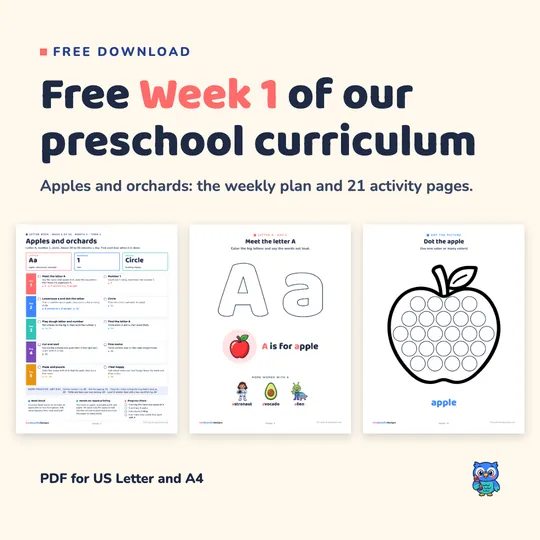
If you would rather not build the year yourself, our 36 Week Preschool and Kindergarten Curriculum puts this whole structure into one download: a plan page for each of the 36 weeks, 915 printable pages, and activities that take about 20 to 30 minutes a day. It comes as PDFs in US Letter and A4 so you can print at home. Whether you use it or build your own, the most important ingredient is a plan you can keep up with.